Stratego Strategy Starts With Information
Most moves in Stratego give your opponent information or win some for you, and a sound Stratego strategy keeps that trade in your favour. An unknown piece could be anything, so your opponent has to treat it with care; a known piece is only as strong as its rank. The short version: never show a strong piece until you have to.
Good Stratego strategies differ in style, some cautious and some aggressive, and the right plan also shifts as the game goes on. Early on, players risk small pieces to learn the enemy layout. By the endgame most pieces are known or guessed, and movement and timing decide it, much as in chess.
Scouting: Spend Cheap Pieces, Not Officers
Learn enemy ranks with pieces you can afford to lose: Scouts, Sergeants, or a Miner while you still have most of your five. Do not test a piece that has never moved with your Marshal, General or a Colonel. An unmoved piece may be a Bomb, which removes any attacker except a Miner, and even a winning attack shows your opponent where your officer stands.
Scouts make natural probes because they can strike from a distance along an empty line; our rules page explains how Stratego pieces move. Still, a Stratego strategy that throws Scouts away in the first few moves gains little: usually a swap of Scouts and the discovery of a Sergeant or a Lieutenant.
Ration Your Scouts: Stratego Tips From Stronger Players
Your last Scouts are worth far more than your first. Experienced players put it bluntly: the first two are nearly worthless and the last two are very important. Keep one or two for the endgame, where a Scout can find a hidden strong piece, pick off the Spy from a distance, or run to a Flag that has been opened up.
Memory: the Stratego Strategy the Board Won't Do for You
On this free Stratego game you keep track of revealed pieces yourself. In a fight both ranks appear briefly, and right after it the winner carries a small badge showing which rank it beat. A revealed enemy piece soon turns back into a question mark, at the latest when it moves again, so fix its square in your head at once. There is no list of captured pieces and no move log; only the last move stays shaded.
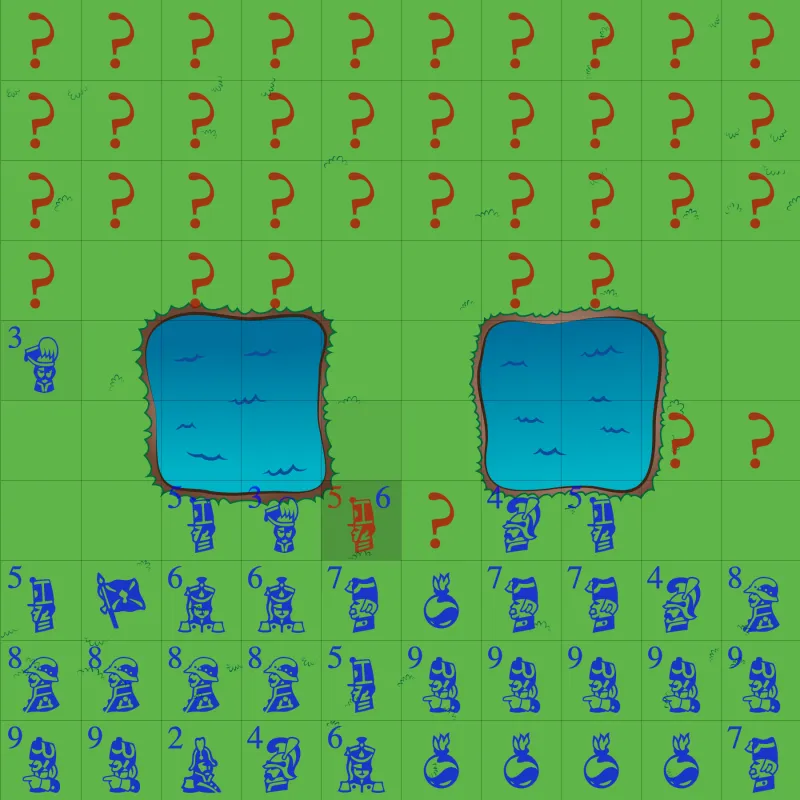
Tournament players get no help either: the International Stratego Federation (ISF) rules allow notes during setup only, and during the match no notes are allowed, "neither on paper nor with the help of any electronic device". Online or across a table, every Stratego strategy leans on memory.
What to Keep in Your Head
Four things are worth remembering:
- enemy pieces that have been revealed or have moved;
- your own moved or revealed pieces, because that is what your opponent knows;
- enemy pieces you suspect, and your own pieces that have been bluffing;
- where enemy pieces started.
Remember Safe Squares, Not Every Piece
Forty enemy pieces are too many to follow one by one. There is a shortcut: a square that any piece has moved from or into cannot hold a Bomb. So remember bomb-free areas, such as "the first two rows on the left are clean". These areas only grow and tend to form simple rectangles, which is much easier than tracking every piece.
Bluffing as a Stratego Strategy
Bluffing means moving a piece the way a different piece would move. It is fair play: you never announce a rank, and true ranks show when pieces meet. A good bluff makes your opponent spend strong pieces, Miners or time on the wrong target.
Make a Weak Piece Look Strong
Send a Miner or a Sergeant straight at a moved enemy piece as if it were an officer. Your opponent may step back, or answer with a strong piece and show you where it is. The middle game is the usual time for it: Miners sent out like officers can draw out the last enemy Scouts or reach a Bomb.
Make a Strong Piece Look Weak
The reverse works too. An unrevealed Marshal that chases a Sergeant can pass for a Captain or a Major, and that may tempt a General or a Colonel to attack it.
Leave a Piece Still So It Looks Like a Bomb
A piece that never moves, especially one tucked into a corner, may be taken for a Bomb. Strong enemy pieces then stay away, and your opponent may waste a Miner on it.
Back Up an Attack, Even With a Weak Piece
When you attack, try to have a second piece next to the target. Your opponent then has to fear a recapture, even if your second piece is only a Miner.
Marshal and General: Stratego Strategy for Your Strongest Pieces
Your Marshal is worth most while nobody knows where it is, so keep it unknown and within reach of the fighting; many players keep it just behind a lake. Do not reveal it to take a small piece. Once your opponent knows where your Marshal is, their General can roam everywhere else on the board.
A basic Stratego strategy for captures is to use a piece only a little stronger than the target: take a revealed Lieutenant with a Captain, not with your General. The capture reveals the piece that made it, and that information is often worth more than the piece you took.
Avoid parking your Marshal in the middle of a lane and leaving it there. When your opponent parks theirs, stay calm: develop both sides of the board and threaten the parked Marshal until it has to back off.
Spy Tactics: Guarding Your Marshal and Setting a Trap
The Spy's one trick only matters while both Marshals are on the board. A common Stratego strategy is to keep the Spy close to the General, so once your Marshal is known, do not stop next to an unknown piece near the enemy General. The computer on our Stratego vs Computer page showed us how costly that mistake is: in four test games its Spy took our Marshal four times, three of them right after the Marshal had captured a piece next to it.
Your own trap works the same way. Put your Spy next to your General. If the enemy Marshal takes the General, your Spy attacks the Marshal on its new square and removes it.
To get rid of the enemy Spy, attack it with anything, because the Spy loses to every attacker. A Scout is a good choice: it costs little and can strike from a distance. For the exact rule on what beats the Marshal, see our Stratego rules.
Trading Pieces: A Simple Stratego Strategy
When two equal pieces fight, both are removed, so a swap only helps when it leaves you ahead. One simple Stratego strategy is built on exactly that: play carefully until you are one piece up, then trade your Marshal for theirs, your General for theirs and so on down, until you have a piece the opponent cannot beat. Players who trade this way also attack only pieces that have moved.
Two cautions. Do not trade an unknown piece, especially an unmoved one, for a known piece: you give away a secret for nothing. And bring a revealed piece back next to friendly pieces instead of leaving it alone.
Endgame Stratego Strategy: Miners, Scouts and the Last Pieces
Endgame Stratego strategy centres on the pieces that can still search: Miners and Scouts. Keep at least one Miner within reach of each lane, because some players close a lane with Bombs in the front row. Clear only the Bombs that block your way or might guard the Flag, and ignore the rest.
A last Scout is hard to catch, and it can find an unknown strong piece or reach an open Flag. Stronger players often still have one or two Scouts at the end, a habit worth copying.
Under the ISF rules there are two answers to how to win at Stratego: capture the Flag, or leave your opponent unable to make any move; if neither player can move, it is a draw. So a Flag surrounded by Bombs grows stronger late in the game: once your opponent has no Miners left, it cannot be reached.
Do not give up after losing your Marshal or General. Many players quit at that moment, yet the game can still turn: our one win against the computer came a single move after its Spy took our Marshal.
Common Stratego Strategy Mistakes to Avoid
Most Stratego strategy mistakes give information away for nothing. These Stratego tips for beginners cover the usual ones:
- Hitting pieces that have never moved with an officer.
- Using up Miners as Scouts, then running short when the Bombs appear.
- Moving lots of new pieces without a plan. Every moved piece becomes a target; a good rule of thumb is fewer than six on the move at a time.
- Forgetting which of your own pieces your opponent has already seen.
- Using the same Bomb pattern every game. Our Stratego setups page has layouts you can rotate.
Practise Your Stratego Strategy Online
You can play Stratego online on our homepage. Random opponents from the online pool test how well you read a setup you have never seen, while a private game with a friend lets you test one Stratego strategy at a time. If you would rather practise with no person on the other side, you can play Stratego vs computer. Before your next game, pick a layout from our best Stratego setup guide.