Which Stratego Rules This Page Follows
This page uses the Stratego rules of the International Stratego Federation (ISF), which sponsors the annual Stratego World Championship. The ISF rules build on Jumbo's Stratego Original rules from 2006; the Stratego trademark belongs to Jumbo, which still sells the board game. Older boxes and other publishers' manuals differ in a few places, collected in one table at the end. The free Stratego game on our homepage checks the same Stratego rules for you and refuses any move they do not allow.
The Board, the Armies and the Goal
Stratego is a game for two players on a board of 10 by 10 squares. Two lakes of 2 by 2 squares sit in the middle, leaving three narrow lanes between the two halves. Each player commands an army of 40 pieces, one red and one blue.
Every piece shows its rank only to its owner. You can see where the enemy pieces stand, but not which piece is which, until a battle reveals them.
The goal is to capture the enemy Flag. You also win if every enemy piece that is left is stuck with no legal move. Red moves first, then players take turns; unlike in chess, moving first gives no real advantage.
Stratego Setup Rules
The Stratego rules have each player place all 40 pieces in the four rows nearest to them, one per square, before play starts. The two middle rows stay empty, and neither player sees the other's layout. Both armies are identical: 33 pieces that move, plus six Bombs and the Flag, which never leave their squares unless they are captured.
From strongest to weakest, the moving pieces are the Marshal, General, Colonel, Major, Captain, Lieutenant, Sergeant, Miner, Scout and Spy. The game here labels them 1 to 9 for Marshal to Scout and S for the Spy; the count of each and the other numbering are in our table of Stratego pieces and ranks.
Where the Flag and Bombs go is your first real decision, and it is entirely up to you. For layouts you can copy, see our Stratego setups.
How Stratego Pieces Move
The Stratego rules give you one action per turn: move one piece or attack with one piece. You cannot pass.
A normal piece moves one square forward, backward, left or right. It may not move diagonally, jump over another piece, land on a square your own piece holds, or enter or cross a lake. Bombs and the Flag stay on their starting squares.
In the game on this site you drag a piece, or on a phone tap it and then tap where it goes. An illegal move is refused, and the piece stays on its square.
The Scout's Long Move
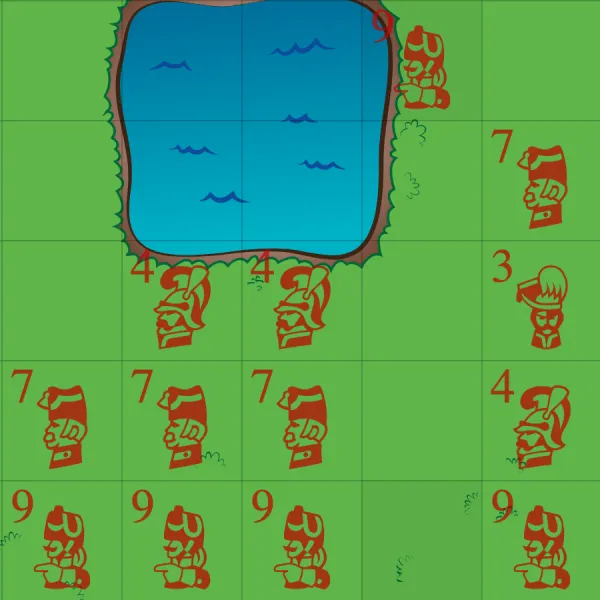
The Scout is the one exception to the one-square limit in the Stratego rules. It moves any number of empty squares in a straight line, like a rook in chess, and stops at the first piece or lake in its way. A long move gives it away: once a piece travels more than one square, your opponent knows it is a Scout.
Attacking: How Battles Work in the Stratego Rules
To attack under the Stratego rules, move your piece onto a square where an enemy piece stands. Both pieces are revealed and the weaker one leaves the board; if both have the same rank, both leave. A winning attacker moves into the square, and a winning defender stays put. The attack is your whole turn, so a normal piece cannot step and then strike.
Strength follows the order of the pieces, not the size of the label. In the game's default labels a smaller number is the stronger piece, so a Captain (5) beats a Lieutenant (6). In sets that number the Marshal 10, the same fight reads 6 against 5, with the same result.
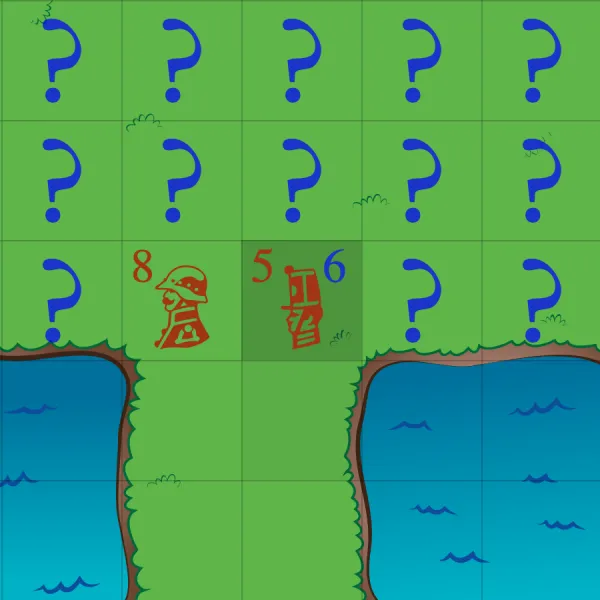
Most battles follow the plain order of strength. The table shows every outcome the Stratego rules allow, special cases included.
| Attacker | Defender | Result |
|---|---|---|
| Stronger piece | Weaker piece | Defender removed, attacker takes the square |
| Weaker piece | Stronger piece | Attacker removed, defender stays |
| Any piece | Same rank | Both removed |
| Spy (S) | Marshal (1, or 10) | Marshal removed |
| Marshal | Spy | Spy removed |
| Spy | Any piece except the Marshal, a Spy or the Flag | Spy removed |
| Miner (8, or 3) | Bomb | Bomb removed, Miner takes the square |
| Any other piece | Bomb | Attacker removed, Bomb stays |
| Any moving piece | Flag | Flag captured, game over |
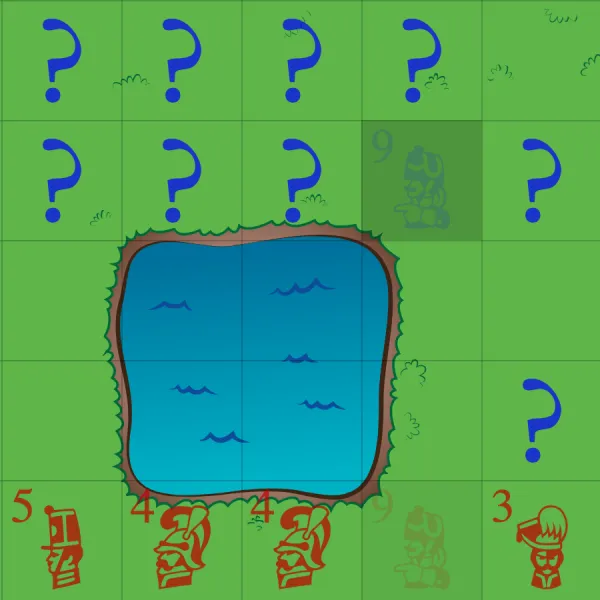
In the game here, both ranks appear for a moment; then the loser disappears and the winner carries a small badge showing the rank it beat.
Stratego Rules for the Spy, Bombs, Miners, Scouts and Flag
Five pieces break the plain order of strength. These are the Stratego rules for each of them.
What Does the Spy Do?
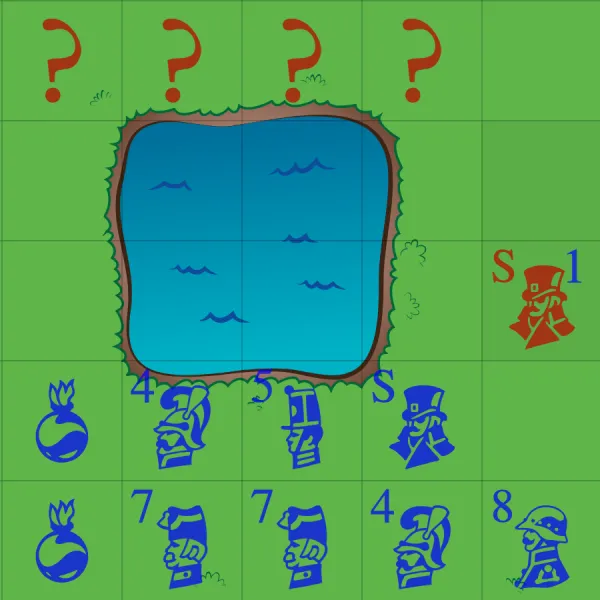
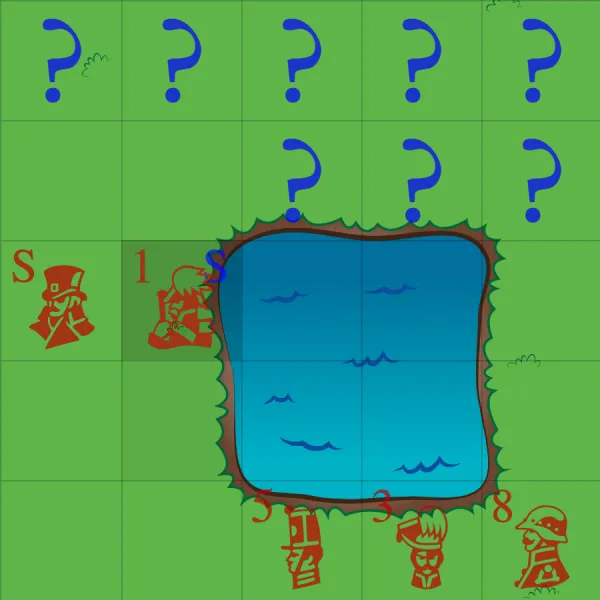
The Spy beats the Marshal, but only when the Spy attacks. If the Marshal or any other piece attacks the Spy, the Spy is removed. When the Spy attacks any other piece or a Bomb, the Spy is removed too. The one exception is the Flag: a Spy that reaches it captures it and wins.
Stratego Bomb Rules
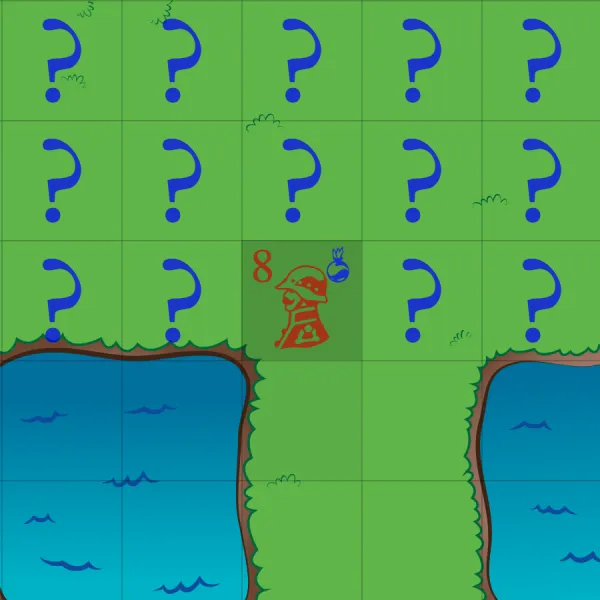
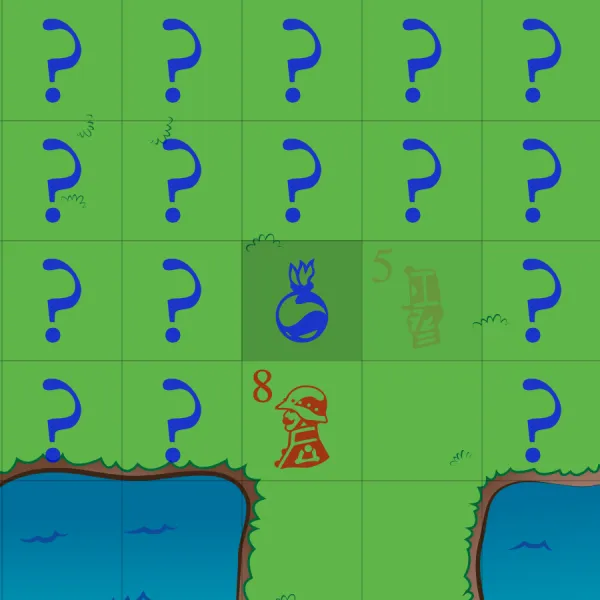
A Bomb never moves and never attacks. Any piece that attacks a Bomb is removed and the Bomb stays, with one exception: a Miner defuses it, the Bomb leaves the board and the Miner moves onto that square. There is no other way to remove a Bomb, which makes the Miner worth far more than its low rank.
Can a Scout Move and Attack in One Turn?
Yes, under the current Stratego rules. A Scout may slide along a line and attack the piece at the end of it in the same move, as long as every square in between is empty. No other piece can do both in one turn. Some older sets and the Hasbro Library Edition forbid it; see the editions table below.
The Flag
The Flag never moves and cannot attack. Under the Stratego rules any moving piece can capture it, even a Spy or a Scout, and the capture ends the game.
The Two-Square Rule and Other Stratego Rules Against Stalling
A piece may not move back and forth between the same two squares more than three times in a row, whatever the opponent does in between. Attacks count as moves, and for a Scout every square it passes over counts as part of the move. The game here refuses the fourth move without a message, so you have to move another piece.
The ISF tournament Stratego rules add a more-squares rule: one piece may not chase another around the board forever, and the chasing player may not keep repeating a position. Both rules exist to stop a player from stalling instead of playing.
How to Win a Game of Stratego, and When It Is a Draw
You win the moment you capture the enemy Flag, or when none of your opponent's remaining pieces can make a legal move. Under the ISF Stratego rules a piece counts only if it has at least one legal move, so a piece whose only move would be a fourth trip between the same two squares does not count. A player may also give up, but the game on this site has no resign button.
A game is a draw when both players agree to one, or when neither player can move.
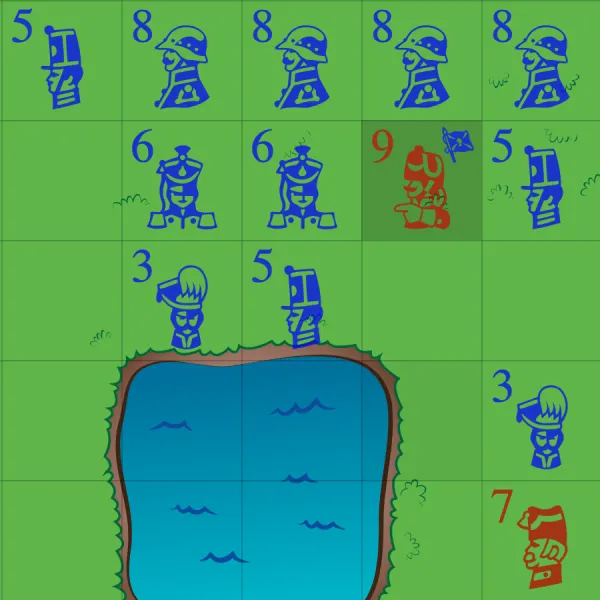
In the game here, capturing the Flag ends play at once: every remaining piece is revealed to both players and a small flag mark appears on the winning piece.
Where Stratego Rules Differ Between Editions
The core Stratego rules are the same in every classic 40-piece set. Three points differ, and the table shows which version this page and the game here use.
| Rule | This page and the game here | Other versions |
|---|---|---|
| Rank numbers | Marshal 1 to Scout 9, Spy S by default; the game's Ranking Style switch shows Marshal 10 to Scout 2, Spy 1 | US editions since 2000 number the Marshal 10 and the Spy 1; older and Classic sets number the Marshal 1 |
| Scout move and attack | Allowed in one turn | Not allowed in older sets or the Hasbro Library Edition |
| Extra pieces | None: the standard 40 | Stratego Original offers an optional Infiltrator piece |
Whichever numbering you learned, the Stratego rules work the same way; only the labels change.
Play Stratego by These Rules
The fastest way to learn the Stratego rules is to use them: play Stratego online against a random opponent or invite a friend with a private link. Our setup examples give you a first layout, and Stratego strategy covers what to do once the pieces start moving. If you would rather play Stratego against the computer, we have a page for that too.